
The Herb Cabinet 本草
升麻 shēng má
Actaea cimicifuga · Chinese cimicifuga rhizome
“The name means "rising hemp" — and rising is the whole résumé. A few grams lift what has sagged, like a pole under a tent roof.” — Lao Xinglin
What the tradition says
Sheng ma does two jobs from one rhizome. In small doses it raises the clear yang — the famous few grams that partner chai hu at the tail of Bu Zhong Yi Qi Tang, lifting sagging qi and prolapsed organs like poles under a tent[1]. In its older career it vents rashes and clears toxin: early measles-type eruptions that need help surfacing, and hot swollen throats and gums[1].
What the research says
A cousin of the black cohosh Western herbalism gives for menopause — but a different species used for different purposes, and the menopause evidence (itself mixed) does not transfer[1]. The Chinese rhizome's triterpenes have laboratory anti-inflammatory signals and no independent clinical base. Worth knowing: Western black cohosh carries rare liver-injury case reports, a caution reasonably extended to the genus.
Where to be careful
Classical dosing is deliberately small — the texts warn that excess brings dizziness and tremor, and withhold it where yin-deficient heat flares upward or rashes have already fully erupted[1]. Not an herb for freelance use; its home is a few grams inside a balanced formula.
In the pharmacy
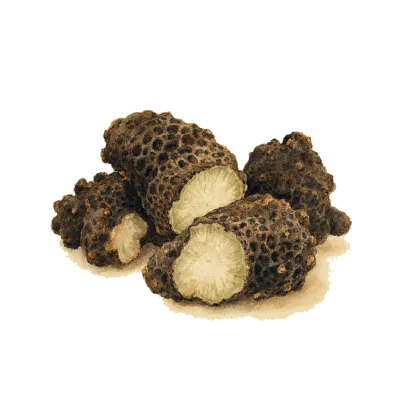
Dark, knobby, honeycomb-pitted rhizomes, sliced to show a greenish-white interior. Honey-fried sheng ma leans further into the lifting role[1].
References
- Bensky, Clavey & Stöger, Chinese Herbal Medicine: Materia Medica, 3rd ed., Eastland Press, 2004. ↩
Under the modern lens
Chemists have catalogued some 244 distinct compounds in shēng má. The ones their papers return to most often:
Constituent records from SymMap v2.0 and TCMSP, retrieved August 2026 and checked by hand. A list of what's inside is a map, not a promise — chemistry alone doesn't prove an effect.
Used in formulas
- 补中益气汤 Bu Zhong Yi Qi Tang Tonify the Middle and Augment the Qi Decoction Envoy — raises the clear yang
 Reviewed 2026-08-26