
The Herb Cabinet 本草
柴胡 chái hú
Bupleurum chinense · bupleurum root
“The unknotter. When qi is stuck — in the flanks, in the temper, in the space between one sigh and the next — this is the root the great formulas are built around.” — Lao Xinglin
What the tradition says
Few roots have chaired more famous prescriptions. Chai hu's signature act is to course the liver and relieve constraint — to restore movement where stress and emotion have knotted the qi — which makes it chief of Xiao Yao San and of the whole Bupleurum family of formulas from the Shang Han Lun[1]. The tradition also credits it with resolving lingering "half-exterior, half-interior" illness — the alternating chills and fever of a battle fought at the threshold — and with raising clear yang when what should lift has sagged[1].
What the research says
Preclinical studies report anti-inflammatory, antiviral, and immune-modulating properties for bupleurum's saikosaponins, but human trials are lacking — the clinical case rests on the formulas, not the lone root[2]. (For the best-studied of those, see the Xiao Yao San evidence.)
Where to be careful
- Dose matters: case reports describe liver damage with excessive doses of bupleurum[2] — an irony the tradition would appreciate, and a reason it is always dosed modestly inside balanced formulas.
- Drug metabolism: it may interact with drugs handled by several CYP enzymes (2C9, 2D6, 3A4 among them)[2].
- The tradition's own note: its rising, dispersing nature can aggravate yin-deficient heat — the flushed, depleted, night-sweating picture[1].
In the pharmacy
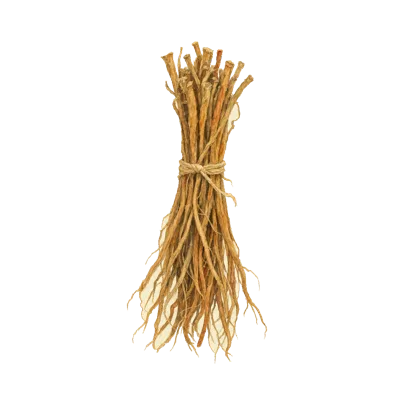
The thin, hard root of Bupleurum chinense — "firewood hu," as the name has it. Vinegar-fried chai hu leans harder into liver-soothing; the raw root into lifting and releasing[1].
References
- Bensky, Clavey & Stöger, Chinese Herbal Medicine: Materia Medica, 3rd ed., Eastland Press, 2004. ↩
- Memorial Sloan Kettering Cancer Center, "Bupleurum" (About Herbs monograph). https://www.mskcc.org/cancer-care/integrative-medicine/herbs/bupleurum ↩
Under the modern lens
Chemists have catalogued some 526 distinct compounds in chái hú. The ones their papers return to most often:
Constituent records from SymMap v2.0 and TCMSP, retrieved August 2026 and checked by hand. A list of what's inside is a map, not a promise — chemistry alone doesn't prove an effect.
Used in formulas
- 逍遥散 Xiao Yao San Free and Easy Wanderer Powder Chief — courses the liver, unknots constraint
- 补中益气汤 Bu Zhong Yi Qi Tang Tonify the Middle and Augment the Qi Decoction Envoy — lifts and raises with sheng ma
 Reviewed 2026-08-25