
The Herb Cabinet 本草
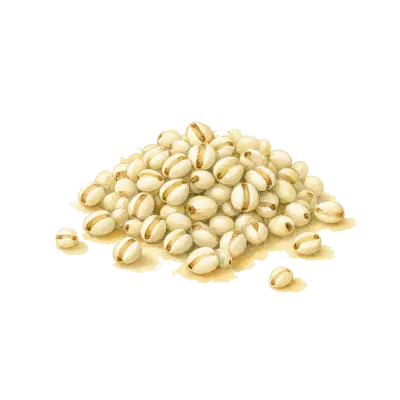
薏苡仁 yì yǐ rén
Coix lacryma-jobi · Job's tears, coix seed
“A grain doing a herb's job, or a herb doing a grain's — the pearl barley of Chinese kitchens, prescribed by the bowl rather than the gram, which tells you most of its safety profile.” — Lao Xinglin
What the tradition says
Yi yi ren is the cabinet's chief drainer of dampness that you can also serve for lunch: pearly teardrop grains simmered wherever the tradition sees waterlogged heaviness — puffy limbs, sodden digestion, damp aching joints, and the damp-heat skin complaints[1]. It strengthens the spleen system while it drains, which is why it appears equally in prescriptions and in Xing Po's soup pot with fu ling, its mushroom colleague in the same trade.
What the research says
The grain (called adlay in the food literature) carries a real research file — laboratory and animal studies on its oils and polysaccharides across inflammation and tumor models[2], enough to keep coix extracts in modern oncology-adjacent research in Asia. Human dietary evidence remains thin, and no bowl of porridge treats any disease; what the trials do agree on is what the kitchen always knew — it is nutritious, gluten-free, and gentle.
Where to be careful
The one firm rule is inherited caution in pregnancy — the classical texts advised against it, and modern references keep the advisory[1]. Otherwise it is food: the main danger is buying pearl barley (a wheat cousin) when you wanted coix, which matters to celiac households since true coix is gluten-free.
In the kitchen
Rinse, then simmer forty minutes (soaked) into congee, the classic winter-melon pork soup, or the Cantonese "four waters" summer drink with mung beans. The tradition's damp-season advice in one bowl: when the air feels like soup, eat the soup that drains it — seasonal eating's tidiest example, labeled as the tradition's logic and enjoyed as lunch.
References
- Bensky, Clavey & Stöger, Chinese Herbal Medicine: Materia Medica, 3rd ed., Eastland Press, 2004. ↩
- "Adlay (yì yĭ; the seeds of Coix lachryma-jobi L. var. ma-yuen Stapf) is a potential cancer chemopreventive agent toward multistage carcinogenesis processes," Journal of Traditional and Complementary Medicine, 2012. https://pubmed.ncbi.nlm.nih.gov/24716141/ ↩
Under the modern lens
Chemists have catalogued some 140 distinct compounds in yì yǐ rén. The ones their papers return to most often:
Constituent records from SymMap v2.0 and TCMSP, retrieved August 2026 and checked by hand. A list of what's inside is a map, not a promise — chemistry alone doesn't prove an effect.
 Reviewed 2026-08-26