
The Herb Cabinet 本草
茯苓 fú líng
Poria cocos · poria, hoelen
“A humble white fungus that grows hidden on pine roots. It does its work the same way — quietly draining what shouldn't be there, calming what shouldn't be racing.” — Lao Xinglin
What the tradition says
Fu ling may be the most-prescribed substance in the entire pharmacy — a bland, neutral fungus dug from pine roots that drains dampness and fortifies the spleen[1]. "Bland" is a compliment here: with no strong flavor pulling in any direction, it percolates excess fluid downward — edema, urinary difficulty, phlegm-fluids — while gently supporting digestion, which is why it partners bai zhu in Xiao Yao San and countless other formulas[1]. Its second gift is quieting: fu ling calms a palpitating, anxious heart, and the version grown around the pine's root core — fu shen (茯神), "poria with spirit" — specializes in exactly that, which is why Gui Pi Tang calls for it[1].
What the research says
Poria polysaccharides and triterpenes are studied in laboratories for diuretic, immune, and sedative signals — in animals and cells, not in clinical trials that would establish a use. Its real evidence is epidemiological in the loosest sense: centuries in half the pharmacy's prescriptions, and even in pastry (Beijing's fuling jiabing wafers).
Where to be careful
Very little — bland, neutral, and food-adjacent. The tradition's only consistent note: those losing fluids they should keep (copious cold urine, sunken deficiency) shouldn't take a drainer[1].
In the pharmacy
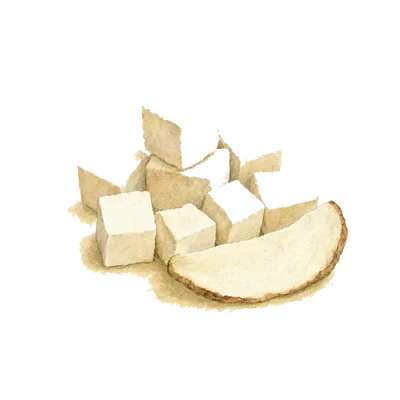
Fist-sized sclerotia of Poria cocos (now Wolfiporia extensa), sold as chalk-white cubes or slices. The outer peel (fu ling pi) drains harder; the root-core fu shen calms best — one fungus, three drawers[1].
References
- Bensky, Clavey & Stöger, Chinese Herbal Medicine: Materia Medica, 3rd ed., Eastland Press, 2004. ↩
Under the modern lens
Chemists have catalogued some 364 distinct compounds in fú líng. The ones their papers return to most often:
Constituent records from SymMap v2.0 and TCMSP, retrieved August 2026 and checked by hand. A list of what's inside is a map, not a promise — chemistry alone doesn't prove an effect.
Used in formulas
- 逍遥散 Xiao Yao San Free and Easy Wanderer Powder Assistant — drains damp, calms the middle
- 归脾汤 Gui Pi Tang Restore the Spleen Decoction Assistant — quiets the heart (fu shen, the root-core poria)
- 六味地黄丸 Liu Wei Di Huang Wan Six-Ingredient Rehmannia Pill Assistant — percolates damp, supports the spleen
- 四君子汤 Si Jun Zi Tang Four Gentlemen Decoction Assistant — drains damp, supports the middle
 Reviewed 2026-08-25