
The Herb Cabinet 本草
三七 sān qī
Panax notoginseng · notoginseng, tienchi
“The battlefield root — it stops bleeding without trapping the bruise, which no other drawer manages. Soldiers carried it; so does every Chinese first-aid shelf since.” — Lao Xinglin
What the tradition says
Ginseng's cousin from Yunnan holds the pharmacy's most paradoxical talent: it stops bleeding while dispersing stasis — staunching the wound without locking the bruise in place[1]. That made san qi the trauma herb: falls, strikes, sprains, battlefield wounds (it headlines the famous Yunnan Baiyao powder), and internal bleeding patterns[1]. The tradition also chews it for chest pain from stasis, classically paired with dan shen.
What the research says
San qi shares the Panax saponin chemistry — over two hundred ginsenosides identified — with laboratory literature reporting hemostatic, anticoagulant, cardioprotective, and anti-inflammatory signals, an oddly two-handed profile that mirrors the traditional claim[2]. Human trials cluster in Chinese cardiovascular practice and haven't yet crossed into rigorous international replication; filed as pharmacologically fascinating, clinically unproven.
Where to be careful
- An herb that touches clotting from both sides deserves respect: avoid alongside anticoagulants and around surgery.
- Traditionally withheld in pregnancy[1].
- The raw/steamed forms are used differently in the tradition (raw for bleeding and stasis, steamed as a tonic) — market products often don't say which they are.
In the pharmacy
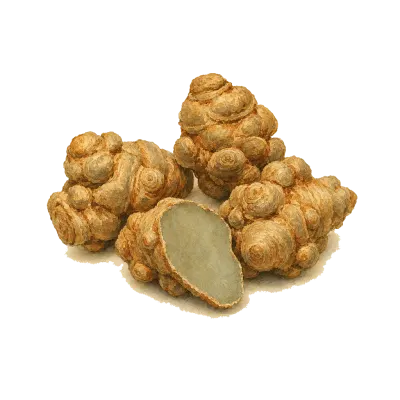
Hard, knobby little roots — "copper skin, iron bone" in the graders' jargon — from Wenshan, Yunnan, sold whole or powdered. The name means "three-seven": three years minimum in the ground, or the leaf-and-stalk count, depending which storyteller you ask[1].
References
- Bensky, Clavey & Stöger, Chinese Herbal Medicine: Materia Medica, 3rd ed., Eastland Press, 2004. ↩
- Zhang X, et al. Panax notoginseng: panoramagram of phytochemical and pharmacological properties, biosynthesis, and regulation and production of ginsenosides. Hortic Res. 2024;11(7):uhae170. https://pmc.ncbi.nlm.nih.gov/articles/PMC11317898/ ↩
Under the modern lens
Chemists have catalogued some 452 distinct compounds in sān qī. The ones their papers return to most often:
Constituent records from SymMap v2.0 and TCMSP, retrieved August 2026 and checked by hand. A list of what's inside is a map, not a promise — chemistry alone doesn't prove an effect.
 Reviewed 2026-08-26