
The Herb Cabinet 本草
丹参 dān shēn
Salvia miltiorrhiza · red sage root
“The crimson root the tradition trusted with the heart itself. One herb, they said, with the powers of four — though the fine print matters more here than anywhere.” — Lao Xinglin
What the tradition says
The red root of a Chinese sage, named as if it were a crimson cousin of ginseng (shen). Dan shen is the tradition's great blood mover for the chest: stabbing chest and abdominal pain, masses, and menstrual disorders from stasis, plus a side gift of cooling the blood and calming a vexed spirit[1]. An old saying claims one herb does the work of the whole Four Substances blood formula. In modern China it became an institution: dan shen preparations are among the most prescribed cardiovascular herbals on Earth.
What the research says
Enormously studied, honestly mixed. The tanshinones and salvianolic acids show real cardiovascular pharmacology in the laboratory, and Chinese clinical use is vast — but rigorous Western trials are sobering: a randomized double-blind crossover trial of the water extract found no benefit on a broad panel of cardiovascular risk factors[3]. Reviews of the interaction literature, meanwhile, treat it as one of the best-documented herb-drug offenders[2].
Where to be careful — read this one
- Warfarin: genuinely dangerous. Dan shen constituents displace warfarin from blood proteins and can potentiate its anticoagulant effect — documented mechanisms plus clinical case reports[2]. If you take warfarin or any anticoagulant/antiplatelet drug, do not add dan shen on your own.
- It can add to bleeding risk generally and is traditionally withheld in pregnancy and without stasis signs[1].
- Anyone on cardiac medication should treat dan shen as a drug that needs a clinician's sign-off, not a supplement.
In the pharmacy
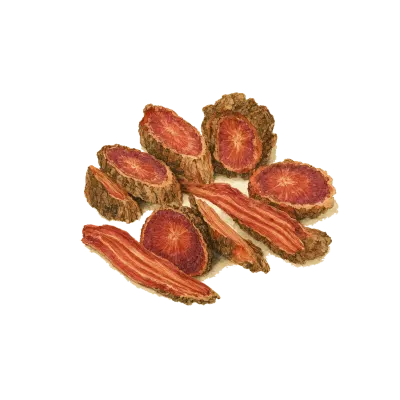
Brick-red to purple-red roots, sold sliced; the color is the tanshinones. Classical pairing: with san qi for the chest — a duo modern patent medicines still bottle.
References
- Bensky, Clavey & Stöger, Chinese Herbal Medicine: Materia Medica, 3rd ed., Eastland Press, 2004. ↩
- Zhou X, et al. Salvia miltiorrhiza roots against cardiovascular disease: consideration of herb-drug interactions. Biomed Res Int. 2017;2017:9868694. https://pmc.ncbi.nlm.nih.gov/articles/PMC5394393/ ↩
- Siebel AL, et al. Salvia miltiorrhiza root water-extract (Danshen) has no beneficial effect on cardiovascular risk factors: a randomized double-blind cross-over trial. PLoS One. 2015;10(7):e0128695. https://pmc.ncbi.nlm.nih.gov/articles/PMC4508048/ ↩
Under the modern lens
Chemists have catalogued some 644 distinct compounds in dān shēn. The ones their papers return to most often:
Constituent records from SymMap v2.0 and TCMSP, retrieved August 2026 and checked by hand. A list of what's inside is a map, not a promise — chemistry alone doesn't prove an effect.
 Reviewed 2026-08-26