
The Herb Cabinet 本草
麦冬 mài mén dōng
Ophiopogon japonicus · ophiopogon tuber
“The little spindle roots of a border-garden grass, plump with stored water — my drawer for throats that lecture, coughs that tickle at midnight, and hearts too dry to settle.” — Lao Xinglin
What the tradition says
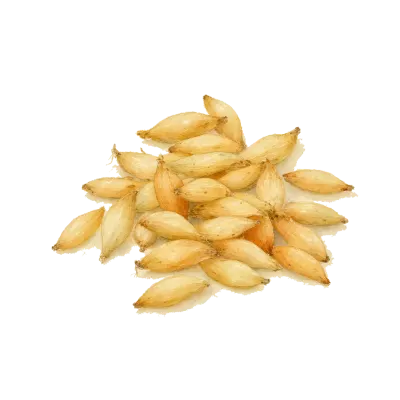
You have walked past this herb: ophiopogon is the mondo grass edging half the world's garden paths, hiding plump little spindle-shaped tubers among its roots. The tradition dug them for moistening: the dry hacking cough, the parched mouth of fevers and long lecturing, dry constipation, and the restless, lightly sleepless heart the classics ascribe to yin run low[1]. It anchors the famous pulse-restoring trio (with ren shen and wu wei zi) and partners shi hu wherever fluids need rebuilding.
What the research says
A serious phytochemical file — steroidal saponins and homoisoflavonoids with cardiovascular and anti-inflammatory activity in laboratory and animal studies, and the pulse-restoring formula is studied (in China) in cardiology settings[2]. For the tuber alone in humans: the familiar quiet. The honest summary is the tradition's own modest one — a gentle moistener with interesting chemistry, not a proven treatment for anything.
Where to be careful
Barely anywhere: it is nearly food. The tradition's one border is the usual one for moisteners — skip it where cold damp already pools (the phlegmy, weak-digestion pattern)[1]. Its slight sweetness makes it one of the easiest herbs to give the reluctant.
In the pharmacy
Ivory spindles, translucent when good, chewy-sweet when steeped. The scholar's classic is mai men dong tea for the overworked voice — a teacher's thermos staple beside monk fruit broth on the throat-comfort shelf. In autumn it joins snow fungus and pear in the season's moistening desserts — the kitchen and the cabinet agreeing, as they often do here, that dryness is best treated deliciously.
References
- Bensky, Clavey & Stöger, Chinese Herbal Medicine: Materia Medica, 3rd ed., Eastland Press, 2004. ↩
- "Ophiopogon japonicus — a phytochemical, ethnomedicinal and pharmacological review," Journal of Ethnopharmacology, 2016. https://pubmed.ncbi.nlm.nih.gov/26826325/ ↩
Under the modern lens
Chemists have catalogued some 110 distinct compounds in mài mén dōng. The ones their papers return to most often:
Constituent records from SymMap v2.0 and TCMSP, retrieved August 2026 and checked by hand. A list of what's inside is a map, not a promise — chemistry alone doesn't prove an effect.
 Reviewed 2026-08-26