
The Herb Cabinet 本草
连翘 lián qiào
Forsythia suspensa · forsythia fruit
“The spring hedge you know from front yards keeps a bitter fruit the tradition calls the sore's holy medicine. Honeysuckle's inseparable other half.” — Lao Xinglin
What the tradition says
The same yellow-flowered shrub that announces Western springs fruits into a bitter little capsule the tradition ranks high among heat-and-toxin clearers. The old texts crown it "holy medicine of sores" (疮家圣药): boils, abscesses, hot swollen nodes and lumps, which it both cools and disperses[1]. Lighter duty pairs it forever with jin yin hua at the top of Yin Qiao San for the feverish, sore-throated start of a heat-type cold — the gold-silver flower cools, the forsythia fruit scatters, and the formula carries both their names.
What the research says
Forsythiaside and related phenylethanoids drive an in-vitro and animal literature of antimicrobial and anti-inflammatory findings; human evidence lives inside the formula trials, with the same honest verdict recorded on the Yin Qiao San page. Its lone solo fame: a component of the oseltamivir-era compound remedies studied in China during flu seasons — suggestive, never settled.
Where to be careful
The bitter-cold fences: not for cold-pattern illness, weak digestion with loose stools, or already-open running sores the tradition judged past dispersing[1]. Otherwise short-course and well tolerated.
In the pharmacy
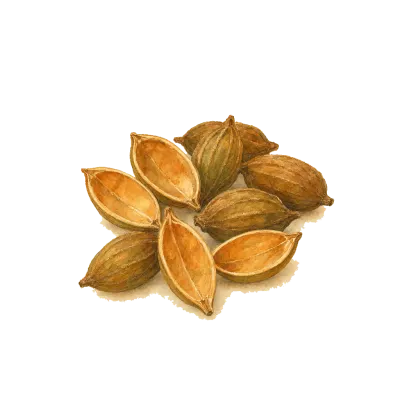
Beaked, ridged little fruits split into halves like tiny boats — the greener qing qiao and riper lao qiao are graded separately, the green judged stronger at clearing[1].
References
- Bensky, Clavey & Stöger, Chinese Herbal Medicine: Materia Medica, 3rd ed., Eastland Press, 2004. ↩
Under the modern lens
Chemists have catalogued some 315 distinct compounds in lián qiào. The ones their papers return to most often:
Constituent records from SymMap v2.0 and TCMSP, retrieved August 2026 and checked by hand. A list of what's inside is a map, not a promise — chemistry alone doesn't prove an effect.
Used in formulas
- 银翘散 Yin Qiao San Honeysuckle and Forsythia Powder Chief — forsythia: clears heat, disperses lumps
 Reviewed 2026-08-26