
The Herb Cabinet 本草
金银花 jīn yín huā
Lonicera japonica · honeysuckle flower
“Gold-and-silver flower — each blossom opens white and turns yellow, two colors on one vine. The tradition's sweetest answer to heat and toxin.” — Lao Xinglin
What the tradition says
The honeysuckle vine flowers white and ages gold, wearing both at once — hence "gold-silver flower." The tradition classes it among the great heat-clearing, toxin-relieving herbs: for hot sore throats, fevers, boils and sores, and the fire-toxin end of infections, while staying sweet and light enough for the earliest stage of a wind-heat cold[1]. That early-stage gift makes it co-chief of Yin Qiao San with its constant partner lian qiao — a pairing so standard the formula is named for the two of them. Summer knows it too: honeysuckle tea is southern China's heat-clearing drink.
What the research says
Chlorogenic acid and luteolin glycosides give the flower a busy laboratory portfolio — antimicrobial and anti-inflammatory signals in vitro and in animals — but human trials stay formula-bound and modest. Filed with its formula: see the Yin Qiao San evidence.
Where to be careful
The cold-and-sweet rules: wrong for cold-pattern conditions — pale, chilly, clear-runny-nose colds — and for weak, cold digestion[1]. As tea or in short formula courses, among the gentler drawers.
In the pharmacy
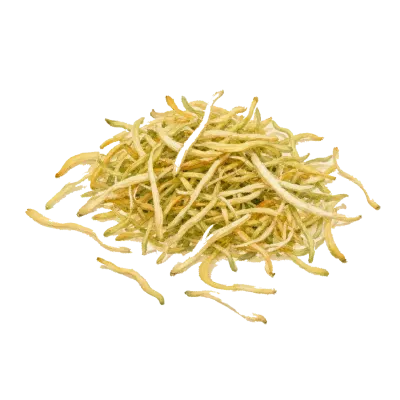
Slender dried buds and just-opened flowers, cream to pale gold; buds picked before dawn opening are the prized grade. The vine's stem (ren dong teng, "winter-enduring vine") is its own drawer for hot, painful joints[1].
References
- Bensky, Clavey & Stöger, Chinese Herbal Medicine: Materia Medica, 3rd ed., Eastland Press, 2004. ↩
Under the modern lens
Chemists have catalogued some 480 distinct compounds in jīn yín huā. The ones their papers return to most often:
Constituent records from SymMap v2.0 and TCMSP, retrieved August 2026 and checked by hand. A list of what's inside is a map, not a promise — chemistry alone doesn't prove an effect.
Used in formulas
- 银翘散 Yin Qiao San Honeysuckle and Forsythia Powder Chief — honeysuckle: clears heat, relieves toxin
 Reviewed 2026-08-26