
The Herb Cabinet 本草
桔梗 jié gěng
Platycodon grandiflorus · balloon flower root
“The balloon flower's root is the pharmacy's boatman — it carries other herbs up to the throat and chest, and opens the lung's doors on the way.” — Lao Xinglin
What the tradition says
The garden balloon flower keeps a working root: jie geng opens and disseminates the lung qi, expels phlegm, and benefits the throat — coughs of either temperature, hoarseness, sore swollen throats[1]. The tradition's favorite metaphor calls it the boatman (舟楫): added to a formula, it ferries the other herbs upward to the chest and throat, which is exactly its posting in Yin Qiao San[1]. Paired with raw licorice it forms the two-herb throat classic Jie Geng Tang.
What the research says
Platycodon saponins (platycodin D) show expectorant and anti-inflammatory activity in laboratory models, and the root is eaten outright in Korea (doraji, the seasoned namul banchan) — a food-grade safety record with, as usual, no independent clinical trial base for the medical claims.
Where to be careful
Its saponins irritate in quantity — nausea at high doses — and the tradition withholds it in coughing of blood[1]. Otherwise a gentle, food-adjacent root.
In the pharmacy
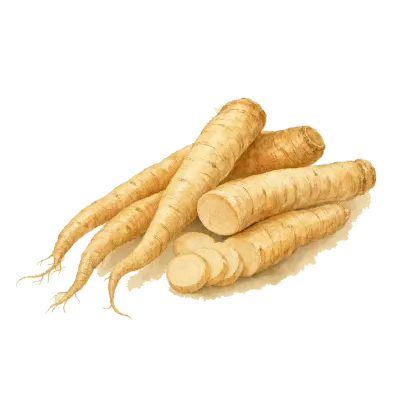
Pale cream taproots, sold sliced or whole — and in Korean groceries, pre-shredded for the dinner table. One plant, three aisles: garden, pharmacy, kitchen[1].
References
- Bensky, Clavey & Stöger, Chinese Herbal Medicine: Materia Medica, 3rd ed., Eastland Press, 2004. ↩
Under the modern lens
Chemists have catalogued some 193 distinct compounds in jié gěng. The ones their papers return to most often:
Constituent records from SymMap v2.0 and TCMSP, retrieved August 2026 and checked by hand. A list of what's inside is a map, not a promise — chemistry alone doesn't prove an effect.
Used in formulas
- 银翘散 Yin Qiao San Honeysuckle and Forsythia Powder Deputy — opens the throat and lungs
 Reviewed 2026-08-26