
The Herb Cabinet 本草
甘草 gān cǎo
Glycyrrhiza uralensis · licorice root
“The peacemaker of the cabinet. It sweetens, softens, and keeps the other herbs from quarreling — though even peacemakers have limits.” — Lao Xinglin
What the tradition says
No herb appears in more classical formulas than gan cao, and its nickname — the "old gentleman of the nation" (国老) — tells you why: it harmonizes. Sweet and neutral, said to enter all twelve channels, licorice moderates harsh herbs, unifies a prescription into one medicine, tonifies the spleen, moistens the lung for cough, eases spasmodic pain, and clears fire toxin from sores and throats[1]. In most formulas it takes the modest "envoy" seat; the honey-fried form (炙甘草, zhi gan cao) is the warmer, more tonifying preparation[1].
What the research says
For all its ubiquity, the evidence for licorice as a treatment is thin: the NIH finds no condition with clearly supportive high-quality evidence, with preliminary signals for mouth ulcers and post-intubation sore throat[2]. The research that is solid concerns safety — see below.
Where to be careful
This is the important section. Licorice contains glycyrrhizin, which in large amounts or over long periods drives potassium down and blood pressure up — a condition called pseudoaldosteronism that can progress to irregular heartbeat and, rarely, cardiac arrest[2][3]. Risk concentrates in people with hypertension or heart or kidney disease, and rises with dose and duration[3]. Inside classical formulas the doses are small and typically short-term, which is exactly how the tradition used it; licorice teas, candies, and supplements taken daily are the usual source of trouble. Deglycyrrhizinated licorice (DGL) removes the compound at issue.
In the pharmacy
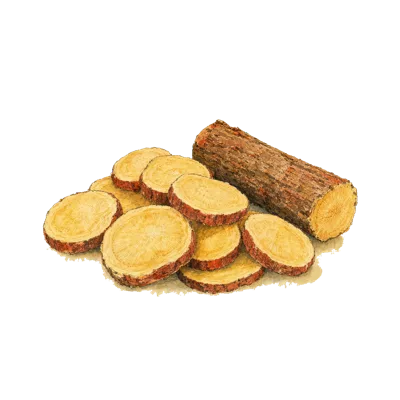
The sweet root of Glycyrrhiza uralensis (or G. glabra), sold raw in yellow slices or honey-fried to a deeper brown. That sweetness is glycyrrhizin itself — some fifty times sweeter than sugar, medicine and hazard in the same molecule.
References
- Bensky, Clavey & Stöger, Chinese Herbal Medicine: Materia Medica, 3rd ed., Eastland Press, 2004. ↩
- National Center for Complementary and Integrative Health (NIH), "Licorice Root: Usefulness and Safety." https://www.nccih.nih.gov/health/licorice-root ↩
- Yoshino T, Shimada S, Homma M, Makino T, Mimura M, Watanabe K. Clinical risk factors of licorice-induced pseudoaldosteronism based on glycyrrhizin-metabolite concentrations: a narrative review. Front Nutr. 2021;8:719197. PMID 34604277. https://pubmed.ncbi.nlm.nih.gov/34604277/ ↩
Under the modern lens
Chemists have catalogued some 558 distinct compounds in gān cǎo. The ones their papers return to most often:
Constituent records from SymMap v2.0 and TCMSP, retrieved August 2026 and checked by hand. A list of what's inside is a map, not a promise — chemistry alone doesn't prove an effect.
Used in formulas
- 逍遥散 Xiao Yao San Free and Easy Wanderer Powder Envoy — harmonizes the whole
- 归脾汤 Gui Pi Tang Restore the Spleen Decoction Envoy — harmonizes the whole
- 四君子汤 Si Jun Zi Tang Four Gentlemen Decoction Envoy — harmonizes and gently tonifies
- 补中益气汤 Bu Zhong Yi Qi Tang Tonify the Middle and Augment the Qi Decoction Deputy — tonifies and harmonizes
- 银翘散 Yin Qiao San Honeysuckle and Forsythia Powder Envoy — soothes the throat, harmonizes
 Reviewed 2026-08-25