
The Herb Cabinet 本草
黄芪 huáng qí
Astragalus mongholicus · astragalus root
“The quiet worker. It lifts the qi and steadies the outside — I give it to those who catch every cold that passes the gate.” — Lao Xinglin
What the tradition says
If ren shen is the emperor, huang qi is the foreman who actually keeps the farm running. The tradition uses this sweet, gently warm root to tonify qi and raise the yang — for fatigue with weakness, poor appetite, and organs that sag from lack of lift — and, most distinctively, to secure the exterior (固表): to firm up the body's defensive layer in people who sweat spontaneously and catch every passing cold[1]. It also appears where the tradition wants tissue pushed to completion: lingering sores that will not close, and swelling from weak circulation of fluids[1].
The defensive-layer idea gave huang qi one of the tradition's loveliest formula names: Yu Ping Feng San, the "Jade Windscreen" — a three-herb screen against the wind, with astragalus as the screen itself.
What the research says
Modern research has looked at astragalus mostly for immune function and metabolic conditions. The NIH's assessment is blunt: there is not yet sufficient reliable evidence to establish it for any condition — recent reviews of diabetes and immune outcomes show promising signals, but the underlying trials have quality problems[2]. A fair reading: interesting, unproven.
Where to be careful
- Because it plausibly stimulates immune activity, people with autoimmune diseases are advised to avoid it, and anyone on immunosuppressive medication should involve their clinician first[2].
- At ordinary doses, oral use otherwise appears relatively safe[2].
- Traditionally it is withheld during acute infection with fever — you don't bar the gate while the intruder is inside[1].
In the pharmacy
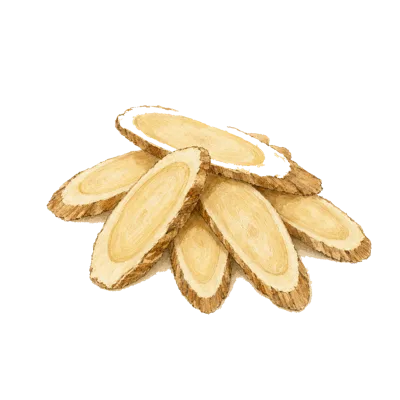
The long, tan taproot of Astragalus mongholicus (also sold under the older name A. membranaceus), sliced like tongue depressors. Honey-fried huang qi (蜜炙黄芪) is the warmer, more tonifying preparation; the raw slice leans toward the exterior-securing and fluid-moving jobs[1].
References
- Bensky, Clavey & Stöger, Chinese Herbal Medicine: Materia Medica, 3rd ed., Eastland Press, 2004. ↩
- National Center for Complementary and Integrative Health (NIH), "Astragalus: Usefulness and Safety." https://www.nccih.nih.gov/health/astragalus ↩
Under the modern lens
Chemists have catalogued some 457 distinct compounds in huáng qí. The ones their papers return to most often:
Constituent records from SymMap v2.0 and TCMSP, retrieved August 2026 and checked by hand. A list of what's inside is a map, not a promise — chemistry alone doesn't prove an effect.
Used in formulas
- 归脾汤 Gui Pi Tang Restore the Spleen Decoction Chief — tonifies qi, lifts what sags
- 玉屏风散 Yu Ping Feng San Jade Windscreen Powder Chief — secures the exterior, tonifies defensive qi
- 补中益气汤 Bu Zhong Yi Qi Tang Tonify the Middle and Augment the Qi Decoction Chief — tonifies qi and raises the sunken yang
 Reviewed 2026-08-25