
The Herb Cabinet 本草
红花 hóng huā
Carthamus tinctorius · safflower
“The dyer's flower that colors silk and moves blood — feather-light threads of flame the tradition scatters wherever circulation has stalled. Light in the hand, and not to be handled lightly.” — Lao Xinglin
What the tradition says
Before it was medicine it was dye — the flower that turned imperial silks red — and the tradition kept the logic of the vat: where blood has stalled and darkened, hong hua restores the flow. The florets appear wherever the classics diagnose blood stasis: the clotted, stabbing sort of menstrual cramps, absent periods, the fixed bruise-like pains of injury[1]. It runs in famous harness with tao ren (peach kernel) in the great blood-moving formulas, and the women's-health room files it on the moving shelf, opposite dang gui's nourishing one.
What the research says
Its yellow pigment (hydroxysafflor yellow A) is a busy research subject — cardiovascular and anticoagulant-adjacent activity across laboratory and animal studies, and safflower-pigment injections are used within Chinese hospitals[2]. Independent human trials of the floret itself are scarce. Note the kitchen distinction: safflower oil, from the seeds, is ordinary cooking oil with none of the floret's reputation — the medicine is the flower.
Where to be careful
The blood-mover's rules, stated without softening[1]:
- Pregnancy: no. The tradition's firmest contraindication for this drawer — blood-movers and pregnancies do not mix.
- Blood thinners and bleeding disorders: the same warfarin conversation as dan shen — additive anticoagulant effects are exactly what the chemistry predicts[2].
- Heavy periods: wrong direction entirely.
In the pharmacy
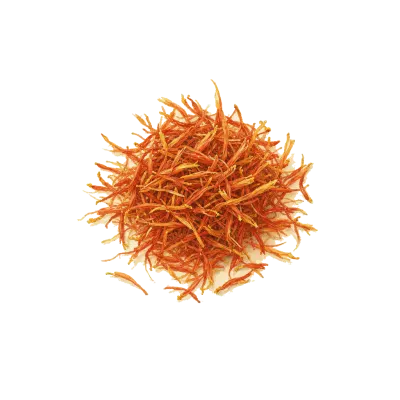
Weightless tangles of orange-red threads, gold at the tips — sold by the pinch, steeped to a sunset-colored tea, or slipped into liniments for bruises. Buyers' note: true saffron costs a hundred times more, and unscrupulous stalls sell hong hua in its costume; saffron threads carry a trumpet-flare tip that safflower lacks. Xing Po, who has never been fooled by anything, checks anyway.
References
- Bensky, Clavey & Stöger, Chinese Herbal Medicine: Materia Medica, 3rd ed., Eastland Press, 2004. ↩
- "Phytochemistry and Pharmacology of Carthamus tinctorius L.," American Journal of Chinese Medicine, 2016. https://pubmed.ncbi.nlm.nih.gov/27080938/ ↩
Under the modern lens
Chemists have catalogued some 685 distinct compounds in hóng huā. The ones their papers return to most often:
Constituent records from SymMap v2.0 and TCMSP, retrieved August 2026 and checked by hand. A list of what's inside is a map, not a promise — chemistry alone doesn't prove an effect.
 Reviewed 2026-08-26