
The Herb Cabinet 本草
钩藤 gōu téng
Uncaria rhynchophylla · uncaria hook, cat's claw vine
“A vine that climbs by little claws, cut into hook-bearing segments — the tradition uses the hooks to catch wind rising in the body: tremor, dizziness, the pounding irritable head.” — Lao Xinglin
What the tradition says
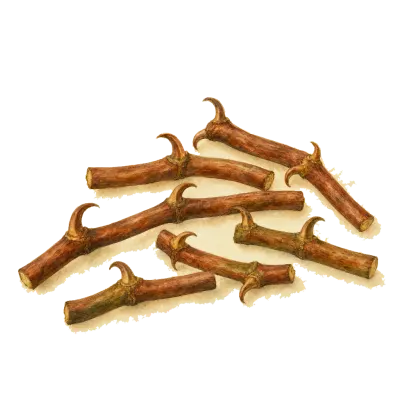
Gou teng climbs the southern forests on paired recurved hooks — little cat's claws on a smooth red-brown stem — and the pharmacy cuts it precisely at those nodes: the hooks are held to carry the strength. Its job is settling liver wind and draining liver heat: the dizzy, tremulous, irritable presentations — pounding temple headaches, tics and tremors, children's fever-convulsions in the classical texts — and always in partnership with tian ma, hook and tuber, the standard wind-settling pair of the headache room[1].
What the research says
The vine's indole alkaloids — rhynchophylline above all — have a genuine pharmacology file: blood-pressure-lowering, sedative, and neuroprotective actions across laboratory and animal studies[2], which sits neatly beside the traditional "descends rising wind and heat" job description. Human trials of the herb alone remain scarce; the famous tian-ma-and-gou-teng formula is studied (mostly within China) for hypertension with the usual small-trial caveats. Interesting chemistry, honest question marks.
Where to be careful
Its cold, descending nature makes it wrong for cold-pattern constitutions without heat signs[1]; anyone on blood-pressure or sedating medication should treat concentrated extracts as active company for their prescriptions[2]; and no relation, despite the shared nickname, to Peruvian cat's claw (Uncaria tomentosa) — a different species with a different résumé.
In the pharmacy
Short smooth stem segments, each bearing one or two glossy hooks — more hooks, better grade. One craft rule every apprentice learns: gou teng goes in last. Long boiling destroys its alkaloids, so the hooks join the decoction for only the final five minutes[1] — the rare drawer where the tradition's kitchen instinct and the chemist's degradation curve are the same sentence. Xiao Hu regards the hooks as professional equipment and has requested a set.
References
- Bensky, Clavey & Stöger, Chinese Herbal Medicine: Materia Medica, 3rd ed., Eastland Press, 2004. ↩
- "A review on indole alkaloids isolated from Uncaria rhynchophylla and their pharmacological studies," Fitoterapia, 2013. https://pubmed.ncbi.nlm.nih.gov/23376412/ ↩
Under the modern lens
Chemists have catalogued some 182 distinct compounds in gōu téng. The ones their papers return to most often:
Constituent records from SymMap v2.0 and TCMSP, retrieved August 2026 and checked by hand. A list of what's inside is a map, not a promise — chemistry alone doesn't prove an effect.
 Reviewed 2026-08-26