
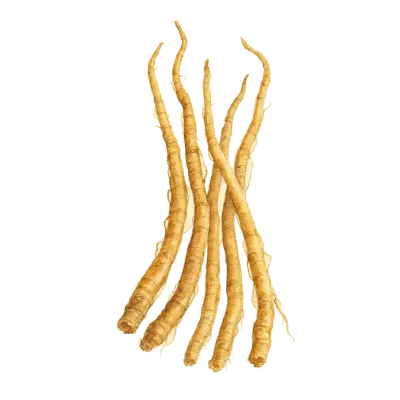
The Herb Cabinet 本草
防风 fáng fēng
Saposhnikovia divaricata · siler root
“The name is the job description — "guard against wind." The gentlest of the wind-expellers, trusted even where stronger dispersers would do harm.” — Lao Xinglin
What the tradition says
"Wind" is the tradition's name for what arrives suddenly from outside — chills, aches, itching, spasm — and fang feng is its appointed guard. The old texts prize it as the gentlest of the wind-expelling roots: moist rather than harsh, safe where drier dispersers would wound, useful for wind-cold aches, wind-damp joint pain, and itching rashes[1]. Its most famous post is in Yu Ping Feng San, patrolling outside the screen huang qi builds — the classic image of tonics and dispersers working the same gate.
What the research says
Chromones and coumarins from the root show anti-inflammatory and analgesic signals in laboratory models; there is no independent human trial base. Its reputation rests on classical formularies, where it appears wherever "wind" needed a courteous escort out.
Where to be careful
The tradition's own fences only: as a disperser it is withheld where sweating is already excessive from deficiency, and in spasm from blood deficiency rather than wind[1]. Among the milder drawers otherwise.
In the pharmacy
Long, soft-fibered tan roots of Saposhnikovia divaricata with a "chrysanthemum heart" cross-section, sliced into flexible rounds. The name alone — guard against wind — has sold it for two thousand years[1].
References
- Bensky, Clavey & Stöger, Chinese Herbal Medicine: Materia Medica, 3rd ed., Eastland Press, 2004. ↩
Under the modern lens
Chemists have catalogued some 271 distinct compounds in fáng fēng. The ones their papers return to most often:
Constituent records from SymMap v2.0 and TCMSP, retrieved August 2026 and checked by hand. A list of what's inside is a map, not a promise — chemistry alone doesn't prove an effect.
Used in formulas
- 玉屏风散 Yu Ping Feng San Jade Windscreen Powder Assistant — 'guard against wind': expels what slips through
 Reviewed 2026-08-26