
The Herb Cabinet 本草
党参 dǎng shēn
Codonopsis pilosula · codonopsis, poor man's ginseng
“When the prescription says ginseng and the purse says otherwise, this is the drawer that opens. Gentler, cheaper, and honest about both.” — Lao Xinglin
What the tradition says
Dang shen is the working family's ren shen: a sweet, neutral root that tonifies the middle and augments qi — fatigue, weak digestion, breathlessness, the everyday depletion picture — without the emperor's intensity or price[1]. Clinics routinely substitute it into the classical ginseng formulas (a common convention: double or triple the weight) for maintenance cases, keeping true ginseng for the steep end[1]. It also nourishes fluids gently and shows up in soups the way huang qi and da zao do — medicine at kitchen temperature.
What the research says
Codonopsis polysaccharides carry a modest laboratory literature — immune and digestive signals in animal models — with no independent clinical evidence base. Its reputation is practical, not experimental: centuries as the default qi tonic of everyday prescriptions.
Where to be careful
Among the gentlest tonics: the standard fences only — not for acute illness with fever, not for heat-excess patterns[1]. Its very mildness is the reason it substitutes for ginseng, and the reason it shares few of ginseng's cautions.
In the pharmacy
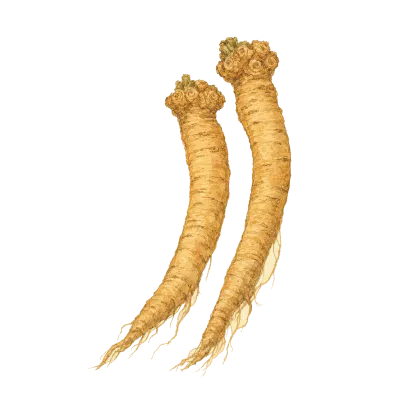
Long, wrinkled tan roots with a characteristic "lion's head" of stem scars at the crown, sweet enough to chew like licorice-adjacent candy. Named for the old Shangdang region — the same terroir the classics praised for ginseng itself[1].
References
- Bensky, Clavey & Stöger, Chinese Herbal Medicine: Materia Medica, 3rd ed., Eastland Press, 2004. ↩
Under the modern lens
Chemists have catalogued some 341 distinct compounds in dǎng shēn. The ones their papers return to most often:
Constituent records from SymMap v2.0 and TCMSP, retrieved August 2026 and checked by hand. A list of what's inside is a map, not a promise — chemistry alone doesn't prove an effect.
 Reviewed 2026-08-26