
The Herb Cabinet 本草
陈皮 chén pí
Citrus reticulata · aged tangerine peel
“The peel you were about to throw away, aged until it becomes medicine. "Chen" means aged — like a good friendship, it gets more valuable the longer it's kept.” — Lao Xinglin
What the tradition says
Chen pi is thrift elevated to pharmacology: tangerine peel, sun-dried and aged — years, ideally; decades, expensively — until the sharp oils mellow into medicine. It regulates qi in the middle — bloating, poor appetite, nausea, the stuffed-and-sluggish feeling — and dries damp, transforming phlegm in gurgling chests and coughs[1]. It is the definitional herb of the Er Chen ("Two Aged") family of phlegm formulas and the pharmacy's favorite way to keep rich tonics moving, a role it shares with mu xiang[1]. Guangdong's Xinhui peel is the famous terroir — traded, graded, and vintage-dated like wine.
What the research says
The peel's flavonoids (hesperidin) and volatile oils have the usual laboratory portfolio — digestive motility, anti-inflammatory signals — without clinical trials behind the traditional uses. As with the other kitchen herbs, its dossier is centuries of soup, tea, and braise.
Where to be careful
Scarcely anywhere — it flavors half of Cantonese cuisine. The tradition notes its drying warmth: red, dry coughs and yin-depleted heat call for a different tool[1]. Eating quantities of modern peel means eating whatever was sprayed on it — aged medicinal grades and organic peel sidestep this.
In the pharmacy
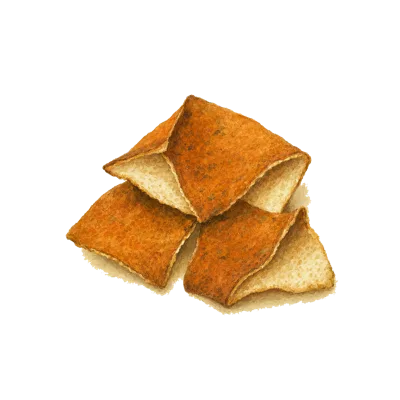
Leathery brown-orange squares that snap cleanly and smell like a citrus grove in autumn. The older, the darker, the dearer. Green immature peel (qing pi) is the harsher, liver-targeting sibling — same fruit, younger temper[1].
References
- Bensky, Clavey & Stöger, Chinese Herbal Medicine: Materia Medica, 3rd ed., Eastland Press, 2004. ↩
Under the modern lens
Chemists have catalogued some 211 distinct compounds in chén pí. The ones their papers return to most often:
Constituent records from SymMap v2.0 and TCMSP, retrieved August 2026 and checked by hand. A list of what's inside is a map, not a promise — chemistry alone doesn't prove an effect.
Used in formulas
- 补中益气汤 Bu Zhong Yi Qi Tang Tonify the Middle and Augment the Qi Decoction Assistant — keeps the tonics moving
 Reviewed 2026-08-25