
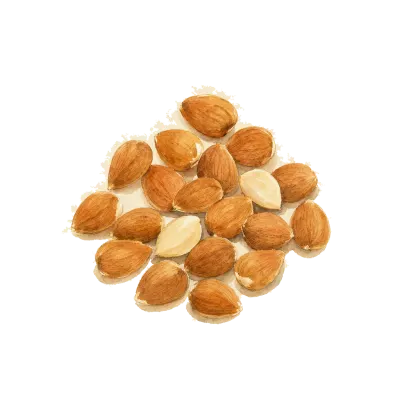
The Herb Cabinet 本草
杏仁 xìng rén
Prunus armeniaca · apricot kernel
“The seed of my own trees — the grove's namesake fruit keeps its medicine in the pit. The tradition prized it for cough, and respected it the way you respect anything with a locked door.” — Lao Xinglin
The grove's own drawer
Of course this cabinet stocks the apricot's kernel — the grove would disown me otherwise. Inside every pit of the fruit that built this place sits a flat, bitter seed the tradition has used for two thousand years to descend rebellious lung qi: cough, wheeze, and the stuffed-chest feeling, plus a side job moistening a dry gut[1]. It appears in cough formulas beyond counting.
The locked-door story, told properly
Bitter apricot kernels contain amygdalin, which gut enzymes convert to cyanide — and that is not folklore but the reason the tradition always processed the seeds, dosed them small, and never fed handfuls to children[1]. The modern chapter is uglier: amygdalin, rebranded "laetrile," was sold as an alternative cancer cure. It is not one — it showed no benefit in animals or patients, it has caused genuine cyanide poisoning, and the FDA banned its sale[2]. This grove grows apricots and tells you plainly: the kernel treats no cancer, and snacking on bitter kernels is a poisoning route, not a wellness habit.
What the research says
Beyond the amygdalin warnings, little human evidence for the traditional cough use — the pharmacology is plausible (small amygdalin doses may calm the cough reflex), the trials are absent, and the margin between dose and harm is the narrowest in this cabinet[1][2]. This is a prescriber's herb, full stop.
In the pharmacy
Prescriptions use processed bitter kernels (ku xing ren), blanched and cooked, in small weighed doses inside formulas. The plump sweet apricot kernels sold as snacks (tian xing ren) are a different, far lower-amygdalin item — the one legitimate casual form. In Xing Po's kitchen the sweet kernels appear in almond-tofu dessert; the bitter ones never leave the doctor's scale. Even the grove keeps a door locked.
References
- Bensky, Clavey & Stöger, Chinese Herbal Medicine: Materia Medica, 3rd ed., Eastland Press, 2004. ↩
- Memorial Sloan Kettering Cancer Center, About Herbs: "Amygdalin." https://www.mskcc.org/cancer-care/integrative-medicine/herbs/amygdalin ↩
Under the modern lens
Chemists have catalogued some 189 distinct compounds in xìng rén. The ones their papers return to most often:
Constituent records from SymMap v2.0 and TCMSP, retrieved August 2026 and checked by hand. A list of what's inside is a map, not a promise — chemistry alone doesn't prove an effect.
 Reviewed 2026-08-26