
The Herb Cabinet 本草
山茱萸 shān zhū yú
Cornus officinalis · Asiatic cornelian cherry
“The sour little mountain fruit whose whole talent is holding on. Whatever the body is losing — sweat, essence, strength at the knees — this one grips.” — Lao Xinglin
What the tradition says
Where wu wei zi astringes the lung and heart, shan zhu yu is the liver and kidney's holder: intensely sour flesh of a mountain fruit, used for leaking essence, incontinence and frequent urination, drenching sweats of collapse, and the deep unsteadiness — sore back, weak knees, dizziness — of kidney depletion[1]. In Liu Wei Di Huang Wan it deputies for rehmannia with a specific genius: it secures what the chief pours in, so the filling doesn't leak away[1]. It also anchors the classical formulas for menstrual flooding.
What the research says
Cornus iridoids (loganin, morroniside) are laboratory subjects for metabolic and kidney-protective signals — animal work, mostly within studies of the six-ingredient formula itself rather than the lone fruit. No independent clinical case yet; filed as traditional.
Where to be careful
The astringent's standard rule: wrong when something should still be draining — acute urinary infection, damp-heat, a fever's sweat[1]. Otherwise a gentle, food-adjacent fruit (Korea makes a tea and wine of it, sansuyu).
In the pharmacy
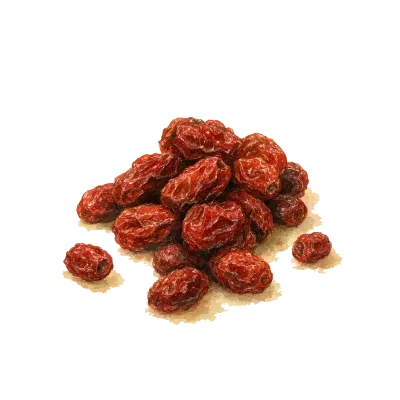
Wrinkled red-black flesh of Cornus officinalis fruits, pitted and dried — sour enough to pucker. Wine-steamed preparation deepens the tonic lean[1].
References
- Bensky, Clavey & Stöger, Chinese Herbal Medicine: Materia Medica, 3rd ed., Eastland Press, 2004. ↩
Under the modern lens
Chemists have catalogued some 432 distinct compounds in shān zhū yú. The ones their papers return to most often:
Constituent records from SymMap v2.0 and TCMSP, retrieved August 2026 and checked by hand. A list of what's inside is a map, not a promise — chemistry alone doesn't prove an effect.
Used in formulas
- 六味地黄丸 Liu Wei Di Huang Wan Six-Ingredient Rehmannia Pill Deputy — secures essence, nourishes the liver
 Reviewed 2026-08-26