
The Herb Cabinet 本草
牡丹皮 mǔ dān pí
Paeonia suffruticosa · tree peony root bark
“The king of flowers keeps a cooling medicine in its root bark. For heat that hides in the blood and flares at night, this is the quiet extinguisher.” — Lao Xinglin
What the tradition says
The tree peony — mu dan, "king of flowers" — gives medicine from below the throne: its root bark cools the blood and moves the blood at once[1]. The classic callings are heat smoldering in the blood level: nosebleeds and rashes, night-time fevers, and the "steaming bone" heat of yin deficiency — plus the stasis side: masses, injuries, and painful menstruation[1]. In Liu Wei Di Huang Wan it is the assistant that damps the flickering fire of depletion while the tonics refill the lamp; in Jia Wei Xiao Yao San it cools what constraint has overheated.
What the research says
Paeonol, the bark's fragrant marker compound, is a busy laboratory subject — anti-inflammatory and microcirculatory signals in animal models — without independent clinical trials of the bark itself. Its evidence lives inside the formulas it serves.
Where to be careful
A cooling blood-mover's standard fences: the tradition withholds it in pregnancy, in cold-pattern conditions, and in heavy menstruation without stasis signs[1].
In the pharmacy
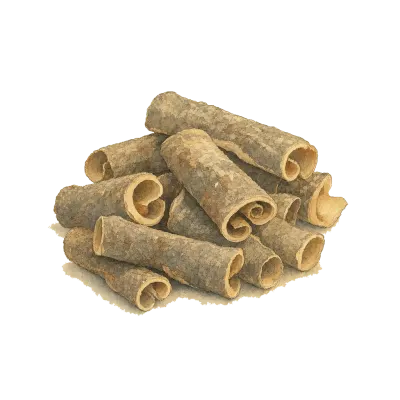
Quilled strips of grey-brown bark with a sweet-medicinal fragrance (paeonol announcing itself), stripped from the roots of garden tree peonies after the flowers have had their fame[1].
References
- Bensky, Clavey & Stöger, Chinese Herbal Medicine: Materia Medica, 3rd ed., Eastland Press, 2004. ↩
Under the modern lens
Chemists have catalogued some 238 distinct compounds in mǔ dān pí. The ones their papers return to most often:
Constituent records from SymMap v2.0 and TCMSP, retrieved August 2026 and checked by hand. A list of what's inside is a map, not a promise — chemistry alone doesn't prove an effect.
Used in formulas
- 六味地黄丸 Liu Wei Di Huang Wan Six-Ingredient Rehmannia Pill Assistant — cools stirring deficiency-fire
 Reviewed 2026-08-26