
The Herb Cabinet 本草
芦根 lú gēn
Phragmites communis · reed rhizome
“The common reed of every riverbank, dug for its sweet water-storing root. When fever has drunk the body dry, this is the drawer that pours a glass.” — Lao Xinglin
What the tradition says
The world's most ordinary wetland plant stores sweet juice in its rhizome, and the tradition put it to the most humane of jobs: generating fluids — quenching the thirst of fevers, soothing the irritable dry heat in lung and stomach, easing the nausea of a hot stomach and, in the old lung-abscess formulas, clearing heat with pus[1]. Fresh, it is practically a beverage; in Yin Qiao San it re-moistens what wind-heat has parched while the flowers fight.
What the research says
Essentially unstudied as a lone medicine — some laboratory antioxidant work on reed polysaccharides — and essentially unquestioned as a safe one: it is closer to sugarcane water than to pharmacology, which is precisely its role.
Where to be careful
Only the obvious: cold and moistening, so unhelpful where the pattern is cold and damp already[1]. Otherwise, one of the few drawers the tradition let fever patients drink freely.
In the pharmacy
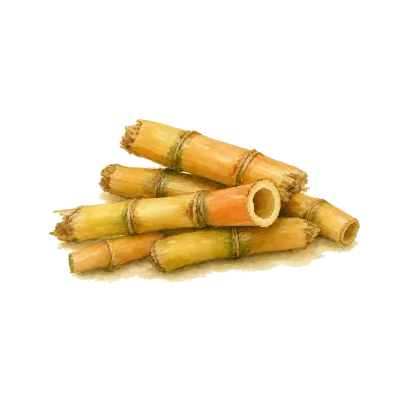
Segmented, hollow, pale-gold rhizomes — fresh and juicy in southern markets (the better grade, says tradition), dried elsewhere; boiled into the pleasant, faintly sweet "reed root water" of convalescent kitchens[1].
References
- Bensky, Clavey & Stöger, Chinese Herbal Medicine: Materia Medica, 3rd ed., Eastland Press, 2004. ↩
Under the modern lens
Chemists have catalogued some 109 distinct compounds in lú gēn. The ones their papers return to most often:
Constituent records from SymMap v2.0 and TCMSP, retrieved August 2026 and checked by hand. A list of what's inside is a map, not a promise — chemistry alone doesn't prove an effect.
Used in formulas
- 银翘散 Yin Qiao San Honeysuckle and Forsythia Powder Assistant — reed rhizome: generates fluids
 Reviewed 2026-08-26