
The Herb Cabinet 本草
龙眼肉 lóng yǎn ròu
Dimocarpus longan · longan, dragon-eye fruit
“Dragon-eye fruit — sweet enough for dessert, kind enough for medicine. For the pale, tired, and sleepless, I'd rather prescribe something that tastes like this.” — Lao Xinglin
What the tradition says
Peel a longan and the name explains itself: a translucent globe with a dark seed at its center — the dragon's eye. The dried flesh is the tradition's most pleasant blood tonic: sweet and warm, it nourishes heart blood and calms the spirit for the palpitations, forgetfulness, and unsettled sleep of the overworked and undernourished[1]. It shares chief duties in Gui Pi Tang, pairing with huang qi so that qi and blood are rebuilt together — and it appears just as often in kitchens, simmered with red dates into the sweet soups a grandmother prescribes for exam season.
What the research says
Longan is studied as a fruit — polysaccharides, antioxidants, mild sedative signals in animal work — not as a clinical therapy. No trial evidence exists to summarize; its standing is culinary, traditional, and affectionate.
Where to be careful
The cautions of any sweet, warming fruit: the tradition withholds it where dampness or phlegm already clog the middle, and in heat conditions[1]. The sugar is real — count it as the candy-adjacent food it is. Otherwise, among the safest drawers in the cabinet.
In the pharmacy
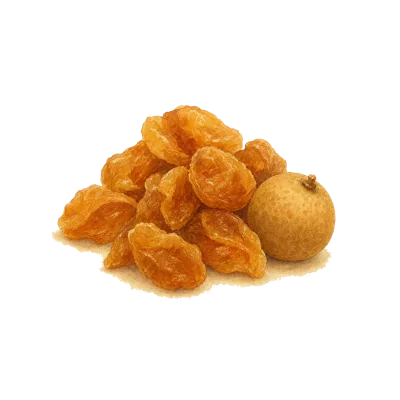
The shelled, pitted, dried flesh of Dimocarpus longan — sticky amber petals of fruit, sold everywhere the diaspora shops. Good long yan rou is plump, dark honey-brown, and shamelessly sweet.
References
- Bensky, Clavey & Stöger, Chinese Herbal Medicine: Materia Medica, 3rd ed., Eastland Press, 2004. ↩
Under the modern lens
Chemists have catalogued some 8 distinct compounds in lóng yǎn ròu. The ones their papers return to most often:
Constituent records from SymMap v2.0 and TCMSP, retrieved August 2026 and checked by hand. A list of what's inside is a map, not a promise — chemistry alone doesn't prove an effect.
Used in formulas
- 归脾汤 Gui Pi Tang Restore the Spleen Decoction Chief — nourishes blood, calms the spirit
 Reviewed 2026-08-25