
The Herb Cabinet 本草
灵芝 líng zhī
Ganoderma lucidum · reishi mushroom
“The mushroom of immortality, if you believe the old stories. I don't promise immortality — but a calmer spirit and a quieter cough were always the honest claims.” — Lao Xinglin
What the tradition says
No herb carries more legend per gram. The glossy, lacquered bracket fungus was the immortals' mushroom of Daoist lore, painted onto scrolls and carved into palace railings. The working tradition is more sober: ling zhi nourishes the heart and calms the spirit (安神) — for restlessness, insomnia, and a racing mind — and boosts qi while transforming phlegm in chronic cough and wheezing[1]. A tonic for the depleted and the frazzled, taken over months, not doses.
What the research says
Laboratory studies show immune-modulating and anti-tumor properties for reishi's polysaccharides and triterpenes, which is why it interests oncology researchers. Clinical evidence is another matter: trials in humans are limited, and randomized studies have not supported some of the popular claims — for instance, reducing cardiovascular risk factors in type 2 diabetes[2]. In cancer care it is studied as an adjunct for immune support and quality of life, never as a treatment[2].
Where to be careful
- Reishi can increase bleeding risk with anticoagulants and may interfere with immunosuppressant drugs[2].
- A quirk worth knowing in oncology: reishi spore powder can elevate the tumor marker CA72-4 without any tumor change, muddying test results[2] — tell your oncologist if you take it.
- Long, high-dose use has been linked to rare liver injury case reports; powdered spore products are the least standardized part of the market.
In the pharmacy
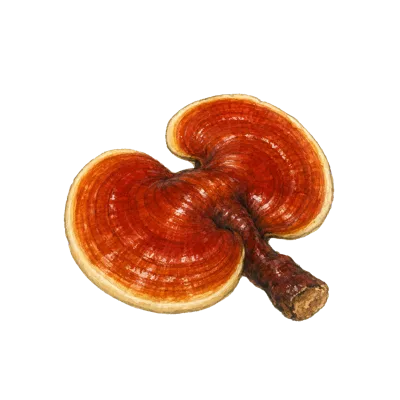
The whole dried cap of Ganoderma lucidum — deep red-brown, kidney-shaped, too woody to eat — sliced for decoction, or sold as extracts and spore powders of wildly varying quality. The tradition brewed the sliced cap long and slow; the modern market mostly sells capsules of everything else.
References
- Bensky, Clavey & Stöger, Chinese Herbal Medicine: Materia Medica, 3rd ed., Eastland Press, 2004. ↩
- Memorial Sloan Kettering Cancer Center, "Reishi Mushroom" (About Herbs monograph). https://www.mskcc.org/cancer-care/integrative-medicine/herbs/reishi-mushroom ↩
Under the modern lens
Chemists have catalogued some 708 distinct compounds in líng zhī. The ones their papers return to most often:
Constituent records from SymMap v2.0 and TCMSP, retrieved August 2026 and checked by hand. A list of what's inside is a map, not a promise — chemistry alone doesn't prove an effect.
 Reviewed 2026-08-25