
The Herb Cabinet 本草
何首乌 hé shǒu wū
Polygonum multiflorum · fo-ti
“Named for a man whose hair turned black again, or so the story goes. I keep this drawer a little higher than the others — read the safety section before you reach for it.” — Lao Xinglin
What the tradition says
The name is a legend: "Mr. He's black hair," after the frail villager who, the story insists, took the root and grew young — dark-haired, long-lived, and abundantly fertile. Beneath the folklore, the tradition uses prepared he shou wu (制首乌, steamed with black-bean juice) to nourish liver and kidney essence: early graying, weak lower back and knees, dizziness, and blood-deficient dryness[1]. The raw root is a different tool — moistening the bowels and resolving toxin — and the tradition itself always separated the two preparations[1].
What the research says — read this one
He shou wu is the cabinet's clearest case of a tradition-versus-toxicology tension. Liver injury from Polygonum multiflorum products is well documented: a 2020 review compiles retrospective analyses covering more than 800 reported cases of he-shou-wu-associated liver injury — mostly reversible on stopping, occasionally severe — with anthraquinone components implicated and raw-root preparations and idiosyncratic susceptibility raising the risk[2]. China's regulators have issued warnings on the herb. Evidence for the hair-darkening and longevity claims, meanwhile, remains folkloric.
Where to be careful
Everywhere, respectfully:
- Do not self-prescribe this herb, and avoid it entirely with any liver condition or alongside hepatotoxic medication[2].
- If it is used at all, that means the prepared form, at modest doses, through a practitioner who knows the case — never the raw root as a daily supplement[2].
- Stop at once and seek care if fatigue, nausea, dark urine, or yellowing appears[2].
In the pharmacy
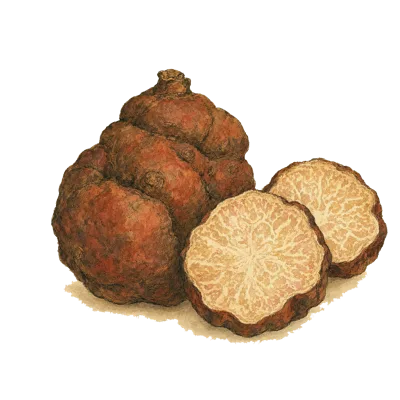
The knobby root of Polygonum multiflorum (now Reynoutria multiflora), sold raw (生首乌) or black-bean-steamed (制首乌) — an old distinction that modern toxicology has turned out to care about too. This is the drawer where "natural" least means "harmless," and the honest page says so.
References
- Bensky, Clavey & Stöger, Chinese Herbal Medicine: Materia Medica, 3rd ed., Eastland Press, 2004. ↩
- Teng et al. Advances in the study of the potential hepatotoxic components and mechanism of Polygonum multiflorum. Evid Based Complement Alternat Med. 2020;2020:9861983. https://pmc.ncbi.nlm.nih.gov/articles/PMC7545463/ ↩
Under the modern lens
Chemists have catalogued some 187 distinct compounds in hé shǒu wū. The ones their papers return to most often:
Constituent records from SymMap v2.0 and TCMSP, retrieved August 2026 and checked by hand. A list of what's inside is a map, not a promise — chemistry alone doesn't prove an effect.
 Reviewed 2026-08-25