
The Herb Cabinet 本草
枸杞子 gǒu qǐ zǐ
Lycium barbarum · goji berry, wolfberry
“The little red berries in every grandmother's soup pot. Gentle enough for the kitchen, respected enough for the pharmacy — food and medicine refusing to be separated.” — Lao Xinglin
What the tradition says
Gou qi zi is where the line between food and medicine happily dissolves. The tradition classes these sweet red berries as a yin and blood nourisher for the liver and kidney: for dizziness, weak knees and lower back, early graying, and above all for the eyes — blurry vision and declining sight are the classic callings[1]. Because it is mild, neutral, and pleasant, it shows up as much in congee, soup, and tea as in prescriptions — the herb a grandmother doses by the handful, not the gram.
The plant is generous: the root bark (地骨皮, dì gǔ pí) is a separate, cooling medicine in its own right — one shrub, two drawers of the cabinet.
What the research says
Modern interest centers on the fruit's polysaccharides and its carotenoid zeaxanthin, which concentrates in the retina — a neat echo of the traditional eye indication, though clinical evidence in humans remains preliminary and mostly small-scale[2]. Trials and reviews exist for immune measures, eye health, and metabolic markers; none yet amounts to proof for a specific condition[2].
Where to be careful
- The one interaction worth memorizing: several case reports describe elevated INR in people taking warfarin after goji tea or goji wine — if you are on anticoagulants, treat goji as a drug, not a snack[2].
- Lycium may also affect how some drugs are metabolized (CYP-mediated), and allergic reactions are reported in people with certain food allergies[2].
- As ordinary food, for most people, it is about as benign as the pharmacopoeia gets.
In the pharmacy
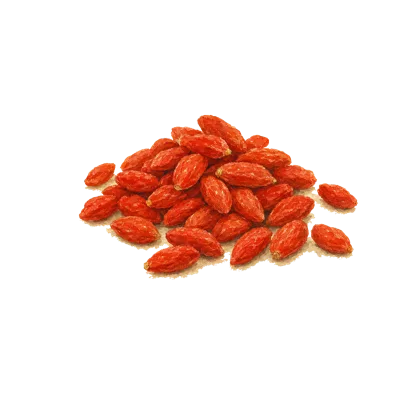
Dried berries of Lycium barbarum, from bright scarlet to brick red — Ningxia's crop is the famous one. Good berries are plump, sweet, and slightly chewy; they go into the pot with the rice, the tea, or straight into the mouth.
References
- Bensky, Clavey & Stöger, Chinese Herbal Medicine: Materia Medica, 3rd ed., Eastland Press, 2004. ↩
- Memorial Sloan Kettering Cancer Center, "Lycium" (About Herbs monograph). https://www.mskcc.org/cancer-care/integrative-medicine/herbs/lycium ↩
Under the modern lens
Chemists have catalogued some 358 distinct compounds in gǒu qǐ zǐ. The ones their papers return to most often:
Constituent records from SymMap v2.0 and TCMSP, retrieved August 2026 and checked by hand. A list of what's inside is a map, not a promise — chemistry alone doesn't prove an effect.
 Reviewed 2026-08-25