
The Herb Cabinet 本草
杜仲 dù zhòng
Eucommia ulmoides · eucommia bark
“Snap the bark and it refuses to let go — silver elastic threads stretch across the break. The tradition looked at that and prescribed it for backs. You can see the logic from here.” — Lao Xinglin
The bark with tendons
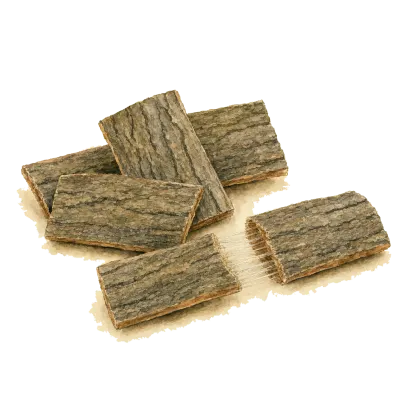
Break a piece of du zhong and it performs its own advertisement: fine silvery threads — a natural rubber — stretch between the halves, refusing the snap. The tradition, which loved a good signature, made it the chief tonic for the aching lower back and weak knees of the kidney-liver department: the loads-bearing herb for the load-bearing joints, and a steadier of restless pregnancy in professional hands[1]. The tree itself is a living fossil, sole survivor of its family, farmed for this bark for two millennia.
What the research says
More than most tonics: reviews catalog a substantial file on blood pressure — lignan-rich extracts lowering it in animal models and small human studies — plus bone-metabolism and anti-inflammatory work in the laboratory[2]. The hypertension thread is real enough that eucommia extracts circulate as supplements for it; the honest label reads promising, small trials, no substitute for medication. A back-pain trial worth the name has yet to be run.
Where to be careful
A warm, well-tolerated reputation, with sensible borders: anyone on blood-pressure medication should treat concentrated extracts as an active ingredient, not a garnish — additive effects are the plausible risk[2]; the tradition skips it in heat-type patterns (it warms)[1]; and its pregnancy uses were always the practitioner's business, never the shelf's.
In the pharmacy
Ridged gray slabs, always snapped at the counter to show the threads — no threads, no sale. It simmers (long) in the classic pork-kidney soup and the walnut-and-bone broths of Xing Po's winter pot; the leaves now brew into a mild tea sold on the extract literature. In the courtyard, grandfather notes, the complementary prescription for aging backs is tai chi — the bark and the practice make an honest pair.
References
- Bensky, Clavey & Stöger, Chinese Herbal Medicine: Materia Medica, 3rd ed., Eastland Press, 2004. ↩
- "Eucommia ulmoides Oliv.: ethnopharmacology, phytochemistry and pharmacology of an important traditional Chinese medicine," Journal of Ethnopharmacology, 2014. https://pubmed.ncbi.nlm.nih.gov/24296089/ ↩
Under the modern lens
Chemists have catalogued some 319 distinct compounds in dù zhòng. The ones their papers return to most often:
Constituent records from SymMap v2.0 and TCMSP, retrieved August 2026 and checked by hand. A list of what's inside is a map, not a promise — chemistry alone doesn't prove an effect.
 Reviewed 2026-08-26