
The Herb Cabinet 本草
淡豆豉 dàn dòu chǐ
Glycine max · bland fermented soybean
“Fermented soybeans, unsalted — the kitchen's douchi gone to medical school. The mildest way the tradition knows to open a fever's front door.” — Lao Xinglin
What the tradition says
Take the black fermented soybeans of the kitchen (douchi), leave out the salt, ferment them with herbal juices, and you have the pharmacy's mildest exterior releaser: dan dou chi gently opens the surface at a fever's start without committing to hot or cold — the diplomat both warm and cool formulas can seat[1]. Its second gift is easing the restless, stuffy irritability that early fevers bring, in the old pairing with gardenia (Zhi Zi Chi Tang)[1]. In Yin Qiao San it quietly helps the flowers vent heat through the front door.
What the research says
It's a fermented food — studied as such (isoflavone changes through fermentation, and the salted kitchen cousin's role in Asian diets) with no clinical literature as a lone medicine. Millennia of dinner stand in for a safety file.
Where to be careful
Almost nowhere: this is among the gentlest entries in the entire cabinet. The only note is the tradition's own — it's a helper for beginnings, not a treatment for an established illness[1].
In the pharmacy
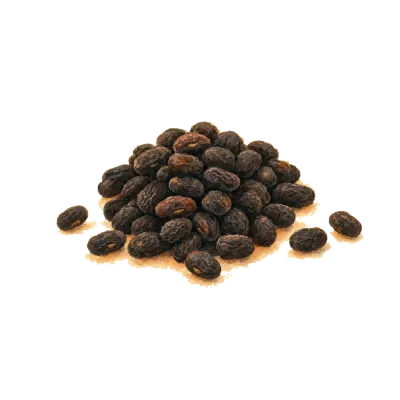
Wrinkled black-brown beans, lighter and blander than the salty kitchen douchi — the preparation (classically with mulberry leaf and artemisia juices) is what turns dinner into medicine[1].
References
- Bensky, Clavey & Stöger, Chinese Herbal Medicine: Materia Medica, 3rd ed., Eastland Press, 2004. ↩
Under the modern lens
Chemists have catalogued some 202 distinct compounds in dàn dòu chǐ. The ones their papers return to most often:
Constituent records from SymMap v2.0 and TCMSP, retrieved August 2026 and checked by hand. A list of what's inside is a map, not a promise — chemistry alone doesn't prove an effect.
Used in formulas
- 银翘散 Yin Qiao San Honeysuckle and Forsythia Powder Assistant — gently releases the exterior
 Reviewed 2026-08-26