
The Herb Cabinet 本草
百合 bǎi hé
Lilium lancifolium · lily bulb
“A hundred petals folded into one bulb — the name means "hundred united." The tradition serves it where the lungs are dry and the heart won't settle, which is to say: convalescence.” — Lao Xinglin
What the tradition says
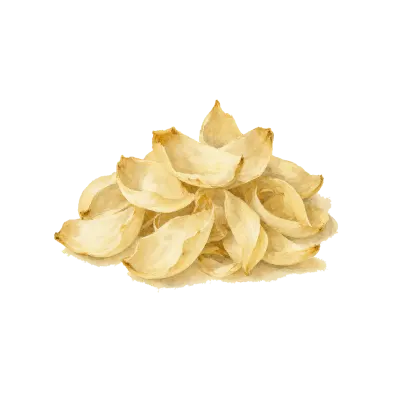
The lily's bulb pulls apart into ivory scales like a flower made of food, and the tradition assigned it two gentle jobs: moistening a dry lung — the tickling, hacking convalescent cough — and settling a restless heart[1]. The classics even named a syndrome for the second use: bai he bing, "lily disease," the distracted, sleepless, can't-say-what's-wrong state after an illness, treated with — of course — lily. It is the cabinet's official herb of recuperation.
What the research says
Food science more than medicine: the bulb's polysaccharides show antioxidant activity in laboratory work[2], and the vegetable itself is nutritious, mildly sweet, faintly bitter at the core. No human trials support the calming or cough claims — this drawer's evidence is two thousand years of soup, labeled exactly so.
Where to be careful
Almost nowhere — this is one of the food-grade drawers: avoid only in the cold-damp cough with abundant thin phlegm (wrong tool — it moistens what is already swamped)[1]. One note from outside the kitchen: cats and true lilies are a genuinely dangerous pairing, so the fresh bulbs stay away from the smaller carnivores of the house. Xiao Hu, a professional, claims exemption; he does not receive one.
In the kitchen
This is where bai he lives in practice — fresh scales stir-fried with celery, dried ones simmered into snow fungus dessert soup and the summer mung bean pot, or cooked into congee with red dates for the recovering. Where sleep is the complaint, the sleep room lays out the whole toolkit; bai he is its gentlest, most edible member.
References
- Bensky, Clavey & Stöger, Chinese Herbal Medicine: Materia Medica, 3rd ed., Eastland Press, 2004. ↩
- "Structural characterisation, physicochemical properties and antioxidant activity of polysaccharide from Lilium lancifolium Thunb.," Food Chemistry, 2015. https://pubmed.ncbi.nlm.nih.gov/25236248/ ↩
Under the modern lens
Chemists have catalogued some 152 distinct compounds in bǎi hé. The ones their papers return to most often:
Constituent records from SymMap v2.0 and TCMSP, retrieved August 2026 and checked by hand. A list of what's inside is a map, not a promise — chemistry alone doesn't prove an effect.
 Reviewed 2026-08-26